After the Legion of Christ Chapter General in early 2021, the New -first US born- General Director (Superior General), Fr. John Connor set about damage control.
He would take action to compensate the victims of Legion of Christ -now morphed into Regnum Christi Federation- Founder Fr. Marcial Maciel’s rampant sexual abuse of his seminarians in the 1950s, an albatross still hanging around the “reformed” institution’s neck.
Fr. Connor set about his task in a very Legionary and Roman way: Divide and Conquer. In order to do things à la Legion -like any cult would do- he would have to break up the group of seven plaintiffs who had not been taken care of for seven decades (1950-2020). Their case would have forever languised in Vatican archives unless investigative reporters Jason Berry and Gerald Renner had bravely brought their plight to the notice of the English-speaking world in February 1997 with a ground-breaking article in the Hartford Courant. https://www.courant.com/news/connecticut/hc-marcial-maciel-02-1997-story.html
Our readers are familiar with later developments, reported here and in other Catholic media:
Mons. Charles Scicluna’s interview of twenty Maciel victims in New York and Mexico City 2005, brings damaging information to soon-to-be-pope, Cardinal Ratzinger.
Maciel’s death in January 2008 revealing sordid details of his double or multiple life, including mistresses and children.
Vatican investigation (euphemically called “visitation”) of the Legion and RegnumChristi, March 31, 2009,
Vatican “renewal” -never called “reform”- of Maciel’s brain child appoints Mons. Velasio de Paolis as Apostolic Delegate on July 9, 2010. Velasio de Paolis was with the Legion for four years, terminating his intervention at the congregation’s General Chapter in 2014. His work was hampered by his surrendering to the charms of LC Director Fr. Álvaro Corcuera and his coterie, and, among other problems, the desperate and fruitless search for the Legion of Christ’s charism and specific mission.
Fr. Connor’s task was daunting. But, like a Good American, he set about it forcefully and with a clear plan. As we have stated in our previous article, the fate of those early victims of Fr. Maciel’s abuse in Spain and Rome was a stumbling block to damage control among the members ad intra, and image laundering ad extra.
How to break that stubborn monolithic block of the remaining 7 accusers?
DivideandConquer. The strategy was clever. The men were in their eighties. They had been abused in the late 1940s and 1950s and had left the sect not long after in various states of mental and emotional disarray. As we wrote previously, there had been at least twenty victims in that generation. Twenty that were counted. If we were to flesh out (forgive the expression) the total number -realizing how only a small percentage of sex victims acklowledge their abuse and come forward- the number would increase exponentially. Maciel had taught his henchmen how to control leaks and numbers. There could easily be a hundred, just from that period. Remember, we are talking about a serial sexual predador dressed in priest’s clothing. Several of his victims suggest that Maciel founded the Legion of Christ Catholic Religios Order, in the first place, to cultivate his ephobophile harem. Harsh words, and not the writer’s. Remember Maciel’s refined sexual appetite targetted emerging puberty. He, the founder, specialized in initiating the innocent boys into their sexuality. That way he would have total control, body and soul, of “his men”, as he called them.
LEGION OF CHRIST GENERAL STRATEGY
regarding Founder, Fr. Marcial Maciel’s, accusers and other cases of sexual abuse by him and by other Legion seminarians and priests.
MINIMIZE numbers and extent of abuse: “boys will be boys” (Richard John Neuhaus)
DISCREDIT: “angry, resentful, vengeful”, “disgruntled old men”! (Fr. Owen Kearns, LC); a vendetta against the holy founder by ambitious former members, Richard John Nehaus in his “Feathers of Scandal” defense of Fr. Maciel in 2002. (Article since vanished from Internet to a large degree so as not to discredit Fr. Neuhaus, R.I.P. and Legion of Christ.)
STONEWALL UNTIL THEY DIE!
DIVIDE DIE-HARD ACCUSERS: as in the case of recent accusations against Fr. Fernando Martínez, abuser of 8-9 year old girls in Cancun, Mexico, 1991-3; and Maciel’s accusers.
IN THE CASE OF FOUNDER FR. MACIEL’S ACCUSERS:
Divide the group of Maciel’s “classical” victims, the ones who would not go away, would not shut up, and had not done the Legion the favor of dying off.
Sidestep and isolate resolute group leader, José de Jesús Barba, PhD Harvard, who demanded Legion leaders approach the survivors as a group and arrange full settlement of all damages: sexual, physical, personal, psychological, interpersonal, emotional, spiritual, religious… (several still suffer from some form of PTSD)
Deceive Barba into thinking and agreeing to work with Fr. Connor and Legion leadership, through a mutually agreed mediator, to reach a full settlement with victims. Meanwhile Fr. Connor is working diligently behind his back to implement the Legion’s strategy. Legion sign agreement with Barba, with a gag clause. Simultaneously disregarded agreement in order to reach their goal. ( cult characteristic: the end justifies the means).
Approach members individually and secretly, beginning in early 2020 -unbeknowned to Barba- offering them each an “Easter Egg” ($5,000.00, five thousand UScy), as a sign of caring and friendship -not as a settlement. they swear-, knowing that these men were now in their eighties and some of them were living in deep poverty (no property of their own, no steady income, little family support, failing health…)
As the first victims began crumbling and accepted the gift, leak to Legion of Christ and Regnum Christi members -the notice would slowly reach the public- “the victims are being taken care of”.
Take advantage of any chinks in the armor of Maciel victim- accusers to get them to accept gifts and sign agreements.
– Four victims accept the Legion overtures.
-Barba holds to agreement signed with Legion Leadership, refusing to enter into individual negotiations.
-Fernando Pérez Olvera also refuses, but cancer strikes…
Around March 2020 Fernando Pérez Olvera, was diagnosed with pancreatic cancer. Legion pounces with the Easter Egg ruse. Pérez Olvera refuses to accept tiny nest egg. Legion leaders prevail with his wife to accept $10, 000.00 (ten thousand dollars) for his hospitalization.
On May 30, 2020 Fernando Pérez Olvera succumbs to pancreatic cancer in Monterrey, Mexico; with his dying breath he demands Justice from the Legion of Christ/Regnum Christi Federation, led by Fr. John Connor.
On the other hand: Mission Accomplished Fr. Connor! You are a worthy son of arch -schemer, pedophile, imposter, impersonator and malignant narcissist, Founder of the Legion of Christ -now called Regnum Christi Federation- to distance itself from the much maligned, yet Vatican approved, Legion of Christ religious congregation.
P.S. Spanish language article in respected newspaper (El País) three victims of sexual abuse accuse Fr. Connor of cover-up.
The Press sometimes refers to Legionnaires of Christ, perhaps in an allusion to the French Foreign Legion, or American Legion, and maybe because it sounds better to U.S. ears.
I believe the official name is Legion of Christ and Legionaries of Christ. The order/group, founded by Mexican Catholic seminarian Marcial Maciel in Mexico City in 1941 at the age of 21, sprouted a lay movement in the 1960s called Regnum Christi -along the lines of the Opus Dei movement-. Together they morphed into Regnum Christi Federation a few years ago.
Recruited at the age of 17 in Dublin in 1961, I could be considered an Irish co-founder of the order; “cofounder” being a coveted title at the time. I became bilingual and bi cultural Spanish during my 23 years in the Legion, training in Spain and Rome and ministering in the USA and Mexico. I exited in 1984 after an altercation with then superior general Fr. Maciel: I have the honor of being one of the few members who ever dared to confront the untouchable founder in front of other members.
Fr. Maciel embraces newly ordained Paul Lennon at Our Lady of Guadalupe Basilica, Rome, 26 November 1969
Previously published article in 2021 reviewed by J. Paul Lennon, November 22, 2024
Dear Reporter:
The Press sometimes refers to Legionnaires of Christ, perhaps in an allusion to the French Foreign Legion, or American Legion, and maybe because it sounds better to U.S. ears.
I believe the official name is Legion of Christ and Legionaries of Christ. The order/group, founded by Mexican Catholic seminarian Marcial Maciel in Mexico City in 1941 at the age of 21, sprouted a lay movement in the 1960s called Regnum Christi -along the lines of the Opus Dei movement-. Together they morphed into Regnum Christi Federation a few years ago.
Recruited at the age of 17 in Dublin in 1961, I could be considered an Irish co-founder of the order; “cofounder” being a coveted title at the time. I became bilingual and bi cultural Spanish during my 23 years in the Legion, training in Spain and Rome and ministering in the USA and Mexico. I exited in 1984 after an altercation with then superior general Fr. Maciel: I have the honor of being one of the few members who ever dared to confront the untouchable founder in front of other members.
During decades Maciel seduced all and sundry, garnering the admiration of popes, especially Pope JP II. His pedophilia, philandering and ruthless fundraising were finally acknowledged by Church Hierarchy and Legion around 2005 -by which time Maciel was 85! One can only imagine the decades of deceit, silence, avoidance, minimization and coverup!
ReGAIN sprung from the concern of parents, friends and former members in the late 1980s seeking to help active, exiting and former members to recover from their traumatic experience.
ReGAIN launched a webpage and a discussion forum in the 1990s. For our troubles the Legion of Christ sued us in civil court in 2007 and made us take down the discussion forum.
The webpage you are reading survived, continuing to publish extensively about the Legion of Christ/Regnum Christi Federation and other controversial Catholic and Christian groups since the 1990s. On this webpage you will find an abundance of info/critique of LC/RC, perhaps the largest in the English language. Presently there are other blogs in Spanish and French that carry out the same mission: Facebook’s Legioleaks (Spanish language with over 5,000 members, and separate English), La Verdad os hará Libres, and l’énvers du décor …
U.S. Catholic investigative reporters, Jason Berry and Gerald Renner, were instrumental in bringing the story of Maciel, the sexual abuse of his seminarians, the secretive nature of the order, and the founder’s love of money and luxury to world attention beyond Mexico and Spanish speaking countries in the Hartford Courant in 1997; later publishing their critique of Maciel and the Legion in Vows of Silence (2004).
Be aware the Legion was founded by Mexican priest, Fr. Marcial Maciel, and most of the literature about it is in the Spanish language. Fr. Maciel saw the Irish as the Legion’s gateway into the USA and other English-speaking countries. Although the Legion would like to cast itself as an international organization – it is present in many countries- there has always been a strong Mexican element: most major superiors are Mexicans, followed by Spaniards, Irish, U.S. and Canadians, with an occasional German or Italian thrown in for good PR. Unfortunately, Legion and Regnum Christi leadership has consistently been tainted by the leaven of founder, Fr. Marcial Maciel, arch abuser, conman, manipulator of conservative Catholics and popes, and a bare-faced liar.
ReGAIN, in principle, avoids criticizing “The Church” (as in Vatican and Pope) as we believe that the Catholic Church actually consists in the union of all baptized Catholics, irrespective of their rank (see II Vatican Council’s dogmatic constitution Lumen Gentium, chapter 2, The People of God.) We thus distinguish between the Catholic Church and the Catholic Hierarchy (LG chapter 3). In general, we also avoid criticizing “the pope”, as if he were solely responsible for every sin that any one of the 1.378 billion members (in 2021) of the Catholic Church commits.
On the other hand, we hold pope, hierarchy, clergy and religious (monks, brothers, nuns) and ordinary Catholics responsible for their actions and omissions, especially when it comes to grievous offenses against children and the vulnerable.
The Vatican has led a “visitation” – euphemism for “intervention”- of Maciel and his order on two occasions: 1956-59 and 2010-2015(?). Several knowledgeable Catholic writers agree with Lennon that these interventions failed. That is a long and tortuous story. Suffice it to say that the last intervention headed by Apostolic Delegate, Mons. De Paolis failed mostly because instead of investigating Legion superiors he “cozied up to” them, befriended them and left them in their positions rather than cleaning house with Fr. Maciel’s collaborators and accomplices.
Together with many other Catholics, Christians, believers, and people of good will, we complain about the way the Catholic Hierarchy has failed to punish Fr. Maciel, and to investigate and censure several cult-like or coercive religious orders and movements approved by and operating freely within its boundaries. (Catholic Orders and Movements Accused of being Cult-Like, Amazon).
ReGAIN has consistently defended and supported all those abused in any way by Legion founder, Fr. Marcial Maciel, Legion and Regnum Christi superiors/directors and regular members.
Together with many other Catholics and Christians we are becoming more aware of other forms of abuse beyond sexual and physical abuse, such as moral, psychological, spiritual and conscience abuse which have been rampant in churches and religious groups. So, our work must continue.
Please read us, comment, question, feel free to disagree. You do not belong to a coercive controlling group… like we did!
APPENDIX: incomplete list of books about Maciel, Legion, Regnum in English, Spanish, and French, up to 2018.
Aristegui, C. (2010). Marcial Maciel, Historia de un Criminal. Mexico City: Grijalbo.
Athié, A., Barba, J., González, F.M, (2012). La Voluntad de no saber: lo que sí se conocía sobre Maciel en los archivos del Vaticano desde 1944. Mexico City: Grijalbo.
Berry, J. & Renner, G. (2004). Vows of Silence. New York: Free Press;
—– (2006). El Legionario de Cristo. Mexico City: Random House Mondadori.
—– (2011). Render unto Rome, The Secret Life of Money in the Catholic Church. New York: Crown Publishers. See Fr. Maciel, Lord of Prosperity, pp.156-196
Erdely, J., Escalante, P., González, F., Guerrero-Chiprés, S., Mascareñas, C. & Masferrer, E. (2004). El Círculo del Poder y la Espiral del Silencio [The Circle of Power and the Spiral of Silence], La Historia Oculta del Padre Marcial Maciel y Los Legionarios de Cristo. Mexico City: Grijalbo.
Espinosa, A. (2003). El Legionario [The Legionary]. Mexico City: Grijalbo.
—– (2014, 2nd Edit.). El Ilusionista, Marcial Maciel (The Illusionist, Marcial Maciel). Charleston, SC: Createspace
González, F. (2006). Marcial Maciel. Los Legionarios de Cristo: testimonios y documentos inéditos [Marcial Maciel, The Legion of Christ: New testimonies and documents]. Mexico: Tusquets Editores,
González Parga, F. (2012). Yo acuso al Padre Maciel y a la Legión de Cristo. Charleston, SC: Createspace. (Maciel victim; early Legionary).
Keogh, J. (2010. Driving Straight on Crooked Lines, How and Irishman found his heart and nearly lost his mind. Iveagh Lodge Press. (A well-written testimony by one of the first Irish-born LC members).
Léger, X & Nicolas, B (2013). Moi, ancien légionnaire du Christ, 7 ans dans une secte au cœur de l’Église. Paris: Flammarion. (Testimony of French LC)
Lennon, John P. (2012, 2nd Edit). Fr. Marcial Maciel Pedophile, Psychopath and Legion of Christ Founder, From Fr. Richard John Neuhaus to Pope Benedict XVI. Charleston, SC: Createspace.
Martínez de Velasco, J. (2002). Los Legionarios de Cristo, el nuevo ejército del Papa [The Legionaries of the Christ, the Pope’s New Army]. Madrid: La Esfera de los libros.
—– (2004). Los Documentos Secretos de los Legionarios de Cristo [The Secret Documents of the Legion of Christ]. Barcelona: Ediciones B.
Sada, E. (2018) Blackbird – A Memoir; The Story of a Woman Who Submitted to Marcial Maciel, Became Free, and Found Happiness Again. Amazon Digital Services. (Former prominent recruiter of Regnum Christi ‘consecrated’ women.)
Ramírez Mota Velasco (2013). El Reino de Marcial Maciel, La Vida Oculta de la Legión y el Regnum Christi. Mexico City: Temas de Hoy. (Former prominent local superior of RC women)
Ruiz-Marcos, José Manuel. (2006). La orden maldita. La historia oculta de los Legionarios de Cristo [The Accursed Order, the Secret History of the Legion of Christ]. Mexico City: Editorial Planeta.
Torres, A. (2002). La Prodigiosa Aventura de la Legión de Cristo [The Marvelous Adventure of the Legion of Christ]. Madrid: La Esfera de los libros.
—– (2004). No nos dejes caer en la Tentación, Escándalos, dinero y guerras de poder en la Iglesia española [Lead us not into Temptation]. Madrid: La Esfera de los libros.
Fr. Maciel (1920-2008) began abusing his adolescent seminarians soon after the foundation in Mexico City 1941. He was investigated twice by the Vatican, never went to trial in canon or civil law, and lived out his days in luxury and pleasure, unrepentent.
Names of Not Compensated Sexual Abuse Victims of Fr. Maciel, Founder and Superior General of the Legion(aries) of Christ -now morphed into Regnum Christi Federation
Recently deceased while the Legion/Regnum Superiors played cat and mouse, waiting for them to die off:
Saúl Barrales Arellano (maternal surname goes last in Spanish; although people can be named by their maternal surname in certain cases, as in the case of Francisco González, called Parga )
Félix Alarcón Hoyos
Fernando Pérez Olvera
Living Survivors in their 80s,
two of whom are living in abject poverty and illness
José de Jesús Barba Martín
Alejandro Espinosa Alcalá
Francisco González Parga – together with Alarcón, the only other victim ordained to priesthood- went public in 2005 when victims were interviewed by then Vatican Prosecutor, Mons. Charles Scicluna, in Mexico City)
ICSA E-Newsletters share articles or other information of interest or importance to ICSA members . Content of e-newsletters is not necessarily endorsed by ICSA, its directors, staff, volunteers, or members. ICSA provides information from many points of view in order to promote dialogue among interested parties. E-Newsletter Archive
Deception, Dependency, and Dread in the Conversion Process
Michael D. Langone, PhD
Farber, Harlow, & West (1957) coined the term “DDD syndrome” to describe the essence of Korean war thought reform with prisoners of war: debility, dependency, and dread. Lifton (1961), who also studied thought reform employed in Chinese universities, demonstrated that the process did not require physical debilitation. Contemporary cultic groups, which do not have the power of the state at their disposal, have more in common with this brand of thought reform than with the POW variety in that they rarely employ physical coercion. In order to control targets, they must rely on subterfuge and natural areas of overlap between themselves and prospects. As with all Korean era thought reform programs (those directed at civilians and at prisoners), however, contemporary cultic groups induce dependent states to gain control over recruits and employ psychological (sometimes physical) punishment (“dread”) to maintain control. The process, in my view, can be briefly described by a modified “DDD syndrome”: deception, dependency, and dread.
Although the process here described is complex and varied, the following appears to occur in the prototypical cult conversion:
A vulnerable prospect encounters a cultic group.
The group (leader[s]) deceptively presents itself as a benevolent authority that can improve the prospect’s well-being.
The prospect responds positively, experiencing an increase in self-esteem and security, at least some of which is in response to what could be considered “placebo” The prospect can now be considered a “recruit”.
Through the use of “sharing” exercises, “confessions,” and skillful individualized probing, the group [leader(s)] assesses the recruit’s strengths and weaknesses.
Through testimonies of group members, the denigration of the group’s “competitors” (e.g., other religious groups, other therapists), the tactful accentuation of the recruit’s shameful memories and other weaknesses, and the gradual indoctrination of the recruit into a closed, nonfalsifiable belief system, the group’s superiority is affirmed as a fundamental assumption.
Members’ testimonies, positive reinforcement of the recruit’s expressions of trust in the group, discrete reminders about the recruit’s weaknesses, and various forms of group pressure induce the recruit to acknowledge that his/her future well-being depends upon adherence to the group’s belief system, more specifically its “change program.”
These same influence techniques are joined by a subtle undermining of the recruit’s self-esteem (e.g., by exaggerating the “sinfulness” of experiences the recruit is encouraged to “confess”), the suppression or weakening of critical thinking through fatiguing activity, near-total control of the recruit’s time, trance-induction exercises (e.g., chanting), and the repetitive message that only disaster results from not following the group’s “change program.” These manipulations induce the recruit to declare allegiance to the group and to commit to change him/herself as directed by the group. He or she can now be considered a convert embarking on a path of “purification”, “enlightenment”, “self-actualization”, “higher consciousness,” or whatever. The recruit’s dependency on the group is established and implicitly, if not explicitly, acknowledged. Moreover, he/she has accepted the group’s authority in defining what is true and good, within the convert’s heart and mind as well as in the world.
The convert is next fully subjected to the unrealistically high expectations of the group. The recruit’s “potential” is “lovingly” affirmed, while members testify to the great heights they and “heroic” models have scaled. The group’s all-important mission, e.g., save the world, justifies its all-consuming expectations.
Because by definition the group is always right and “negative” thinking is unacceptable, the convert’s failures become totally his or her responsibility, while his or her doubts and criticisms are suppressed (often with the aid of trance-inducing exercises such as meditation, speaking in tongues, or chanting) or redefined as personal failures. The convert thus experiences increasing self-alienation. The “pre-cult self” is rejected; doubts about the group are pushed out of consciousness; the sense of failure generated by not measuring up to the group’s expectations is bottled up inside. The only possible adaptation is fragmentation and compartmentalization. It is not surprising, then, that many clinicians consider dissociation to lie at the heart of cult-related distress and dysfunction (Ash, 1985).
The convert’s self-alienation will tend to demand further psychological, if not physical, alienation from the non-group world (especially family), information from which can threaten to upset whatever dissociative equilibrium the convert establishes in an attempt to adjust to the consuming and conflicting demands of the group. This alienation accentuates the convert’s dependency on the group.
The group supports the convert’s dissociative equilibrium by actively encouraging escalating dependency, e.g., by exaggerating the convert’s past “sins” and conflicts with family, by denigrating outsiders, by positively reinforcing chanting or other “thought-stopping” activities, and by providing and positively reinforcing ways in which the convert can find a valued role within the group (e.g., work for a group-owned business, sell magazines on the street).
The group strengthens the convert’s growing dependency by threatening or inflicting punishment whenever the convert or an outside force (e.g., a visit by a family member) disturbs the dissociative equilibrium that enables him or her to function in a closed, nonfalsifiable system (the “dread” of DDD). Punishment may sometimes by physical. Usually, however, the punishment is psychological, sometimes even metaphysical. Certain fringe Christian groups, for example, can, at the command of the leadership, immediately begin shunning someone singled out as “factious” or possessed of a “rebellious spirit.” Many groups also threaten wavering converts with punishments in the hereafter, for example, being “doomed to Hell.” It should be remembered that these threats and punishments occur within a context of induced dependency and psychological alienation from the person’s former support network. This fact makes them much more potent than the garden-variety admonitions of traditional religious, such as “you will go to hell if you die with mortal sin.”
The result of this process, when carried to its consummation, is a person who proclaims great happiness but hides great suffering. I have talked to many former cultists who, when they left their groups and talked to other former members, were surprised to discover that many of their fellow members were also smilingly unhappy, all thinking they were the only ones who felt miserable inside.
References
Ash, S. (1985). Cult-induced psychopathology, part 1: Clinical picture. Cultic Studies Journal, 2(1), 31-91.
Farber, I. E., Harlow, H. F., & West, L. J. (1956). Brainwashing, conditioning, and DDD (debility, dependency, and dread). Sociometry, 20, 271-285.
Lifton, R. J. (1961). Thought reform and the psychology of totalism. New York: W. W. Norton.
An Interview with Ex-Opus Dei Numerary Eileen Johnson – Part 1
Introduction
The following interview with ex-Opus Dei numerary, Eileen Johnson, was conducted over a period of several months in 2020 and 2021. Eileen is a native of Yorkshire, England, where “a spade is called a spade, and not a bloody shovel.” And indeed, she obliges us with her extraordinary candor and honesty in response to my in-depth questions concerning her more than ten-years-experience as an early high-level member of Opus Dei in the United Kingdom (UK) in the 1960s.
– Randy Engel, Catholic investigative reporter and editor of ODWATCH[1]
Engel: By way of introduction Eileen, would you give our readers some background on your family and education, and how Opus Dei entered your young life?
Johnson: Yes, of course. I was born in Yorkshire, England, in 1943, into a Catholic family on my mother’s side. My father was an agnostic. I have two older brothers. As the youngest and only girl, I attended a Catholic primary school and later a convent Grammar school, which I think your American readers would call a Catholic high school. I was a pious child with a lively spirit who loved to sing and dance. At the age of 15, I seriously considered a religious vocation.
It was about a year later, at age 16, when Opus Dei entered my life – surreptitiously, I might add.
I was an excellent student and class leader. French was my favorite subject. So, it was not surprising when our new young French teacher took a special interest in me and took me under her wing. I was flattered. She was aware of my regular lunchtime visits to the school chapel as she also frequently visited the chapel.
One day she invited me to join her at an international summer school for girls at the Rydalwood University hostel in Manchester where, she said, I could “teach English” and also practice my French. My parents, especially my father, encouraged me to take advantage of this opportunity. They trusted my teacher. I had just turned 17, and this was my first trip away from home on my own. Naturally, I was excited!
Engel: Was the venture successful?
Johnson: As it turned out, I was invited to Manchester under false pretenses.
First of all, I was unable to practice my French because there were no French students taking the course. I wasn’t qualified to teach English either. The invitation was, in fact, a ruse to introduce me to Opus Dei within a closely-controlled Opus environment apart from my family. But I was oblivious to the reality.
Engel: Wasn’t there a visible sign designating Rydalwood[2] as an Opus Dei University hostel when you entered the building?
Johnson: No. The centres have secular names and are not openly identified as being run by Opus Dei. It wasn’t until my French teacher, herself an Opus numerary, started to explain to me what Opus Dei was, that I began to understand the real reason for the invitation. You see, neither I, nor my family or friends, had ever heard of Opus Dei. During the late 1950s and early 1960s, Opus was just getting established in the UK. So, it was all quite new. After a few days, at Rydalwood my teacher told me I had a “vocation” to Opus Dei.
I resisted the pressure to join “the Work” at first. However, a few months later, after I had attended an Opus weekend retreat back in Manchester, I changed my mind.
Engel: What attracted you most to Opus Dei?
Johnson: Bear in mind that I was only 16 when Opus’s grooming and “love bombing” began. I came from a comfortable, happy home, but hadn’t been exposed to cosmopolitan ways. I was on the threshold of my newly-discovered independence and found the Opus members and the beautiful atmosphere at Rydalwood very appealing. I took my Catholic faith very seriously and had already been thinking of becoming a nun. I was attracted by the fact that the numeraries at Rydalwood were lay women fully dedicated to God.
Also, as a language student, I was immediately drawn to the Latin flavor of the centre and the gaiety and friendliness of the numeraries, most of whom were Spanish. They were well dressed, well groomed, well perfumed. And they made such a fuss over me – something I wasn’t used to as I was a lonely child and teenager.
Looking back, I remember the first time that my parents drove me to the Manchester campus and visited Rydalwood. As they were leaving my mother asked me, “Do you think you would like it so much if it wasn’t so attractive?” It was a rather prophetic question.
Engel: So, you initially joined Opus Dei as a supernumerary, not as a numerary, correct?
Johnson: Yes, in December 1960. At the time, I was still living at home, and studying for my A level exams. I planned to enter Manchester University in the fall. I remember fervently reading and studying The Way[3] and other Opus publications. I even sold copies of the publications to my friends at school. I was obviously totally enthralled with Opus Dei.
Engel: What’s the difference between an Opus Dei supernumerary and a numerary?
Johnson: The degree of commitment.
Male and female numeraries are lay celibates; they live in Opus centres; they hand over their total income to Opus Dei; and are closely monitored and controlled. Supernumeraries are married, or at least free to marry. They are also expected to make significant financial donations to Opus. They have Opus confessors and spiritual directors, and a Plan of Life.[4] Both are fully committed to the recruitment of new members and spreading the message of Opus Dei through their families and their work.
I should mention that there are celibate members who live at home. They are called Associates.
Sometimes they have to care for aging or disabled parents.
Engel: Did you take vows of any kind like religious do?
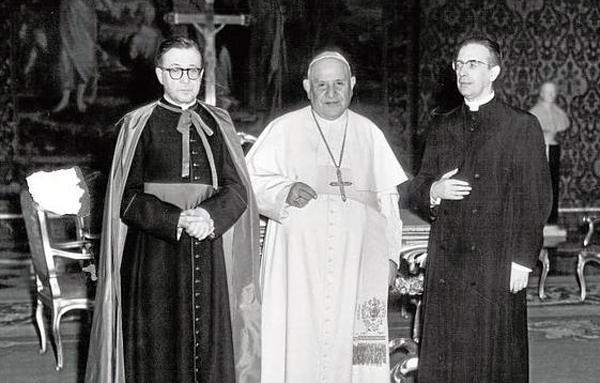
Msgr. Josemaría Escrivá with Pope John XXIII, Ides of March, 1960
Johnson: When I joined Opus Dei in the early 1960s it was called a “Secular Institute.” Escrivá adamantly wanted to avoid any perceived connection between a “lay vocation” in Opus Dei with a “religious vocation.”
So, to answer your question, I took what were called, “private vows.” For me they were binding, even before I formally took them. From the day I “’whistled” (OD jargon for writing the letter to Rome to request admission), I lived as a committed member in every way. The understanding was that the commitment was for life. The Admission ceremony took place six months later in the Opus oratory in the presence of an Opus priest, my directress, and one other numerary.
After Opus Dei was awarded the unique status of “Personal Prelature” in 1982, the term “vow” was changed to “contract,” but the nature of the commitment remained basically the same.
Engel: Was your family present at the Admission ceremony?
Johnson: Hardly. They didn’t know I had joined Opus much less that I had made a lifelong commitment to the Work that included perpetual celibacy. Neither did any of my close friends. As a new recruit I was told not to tell my parents. From the start, it was explained to me that for our apostolate in Opus Dei to be effective it must “pass unnoticed.” Opus Dei deemed our dedication was to be a very private matter between us and God and our sisters in Opus Dei. What many see as “secrecy,” Opus calls “Holy Discretion.”
Engel: No matter what you call it, for a minor to engage in such deception and be instructed to keep such a life-changing association secret from his or her parents is a violation of the Fifth Commandment to honor one’s father and mother. Didn’t your obvious delicate conscience send up a red flag?
Johnson: If it did, I wasn’t paying attention. As I said earlier, I was just bowled over by this new and exciting version of a secular life so fully dedicated to the Church – the Work of God – yet, so upbeat, so vibrant, so warm, and so friendly.
Engel: We’ll be returning to the issue of secrecy as formal Opus policy later in this interview, but for now I’d like to ask you about your relationship with your boyfriend at this time. Was it serious? Did he know about your commitment to Opus?
Johnson: Yes, to both questions. We were serious. We even discussed the possibility of marriage after we graduated from the University. We also came to share a deep attraction to Opus Dei and we both became supernumeraries.
Like me, my boyfriend kept his membership in Opus a secret from his parents. He resided at an Opus Dei men’s University residence. We both were aware at the time that Opus was grooming both of us, but not for each other. Eventually, Opus was able to manipulate our total separation and he eventually joined as a celibate numerary. I found out that he had become a numerary when the directress told me to speak to the priest in the confessional. I was instructed not to contact him again.
Engel: Did he ever pursue the occupation he studied and trained for at the University after graduation?
Johnson: No, I don’t think so. He was a Physics graduate, but Opus needed him elsewhere for internal work. In his early 20s, he became the Director of a male Opus University Centre in London. Later, he was asked by his superiors to become a priest of Opus Dei. He was ordained in Rome at the age of 26. He later became the Counselor (later called Vicar) of Opus Dei for the UK.
Engel: And you?
Johnson: I was told before joining Opus Dei that I would be free to pursue my chosen studies and career in languages. That never happened. In February of 1962, at the age of 18, three months after I separated from my boyfriend, I also changed my supernumerary status to that of a numerary (lay celibates who live in Opus centres) so I could devote my entire life to Opus Dei. This meant I had to “whistle” again and write to the Father to ask to be admitted as a numerary. I never spoke to my boyfriend again.
I was also told by my directress that I would make a good journalist. That idea lodged in my mind and I began to perceive a journalistic career as part of my vocation to serve Opus Dei.
Engel: How did Opus Dei influence your academic and campus life?
Johnson: Well, during my three years at the University, I found myself focusing more on my “Plan of Life” and proselytism than on my studies. In my third year, I was appointed Assistant Directress of Rydalwood, which further detracted from my studies. At the age of 22, I was appointed a member of the Advisory[5] in London. This came as a surprise, and I felt very flattered.
Although, theoretically, Opus places a high premium on excellence in academics as well as work, in my case dedication to the internal needs and tasks of Opus and its expansion in the UK took priority over my personal choices and priorities, and jeopardized my career.
Also, when I entered the University, I had hoped to join the Gilbert and Sullivan Society and the Scottish Country Dance Society, but these were nixed by Opus because they would expose me to the opposite sex. Going to the theater, cinemas and mixed social events were also prohibited.
Engel: At what point did you reveal your membership to Opus Dei to your parents?
Johnson: In June 1964, after I had graduated from the University, I told them that I had an interest in joining Opus now that I had turned 21, which was the age of majority in the UK back then.[6] That was a lie, of course. I had already been a member for years, first as a supernumerary while I was still living at home, and then as a celibate numerary and as an Assistant Directress at Rydalwood.
Engel: So, your parents helped pay for your college costs for four years not knowing of your life-long commitment to Opus?
Johnson: Yes, my father paid a “parental contribution,” to supplement the grant from my local education authority.
Engel: And Opus, who would benefit from all your educational skills and talents after your graduation paid how much?
Johnson: Nothing.
Engel: How convenient, I mean, for Opus.
Johnson: I should add a caveat here to say that during my undergraduate at the University, my father had become ill, so my parents were not as aware of my campus life as they might otherwise have been.
I recall my directress telling me that I needed to “get a balance.” “Since your parents don’t know about your vocation, you can’t stop going home for the holidays,” she advised me. I was reminded of The Way, 644: “Be silent! Don’t forget that your ideal is like a newly lit flame. A single breath might be enough to put it out in your heart.”
On the few occasions that I actually spent at home, my mother did express concern about my social isolation and tried to introduce me to a young man, but that was out of bounds for me as a celibate numerary.
Engel: What about your family relations after your graduation in 1964?
Johnson: After graduation I continued to live at Rydalwood. I rarely saw my parents. Not even at Christmas. As for my brothers, I had almost no contact with them or my sisters-in-laws or their children. Opus did permit me to be a godmother to two of my nephews, but that was before I had informed my family that I had joined Opus Dei.
Overall, Opus discouraged members’ attendance at family events like weddings and funerals. When my cousin, who had been my longtime playmate was married, I went to stay at my parents’ home, but on the morning of the wedding, I feigned illness so as not to attend. I felt no remorse. Rather, I was pleased with myself that I had found a way to “obey.” When my aunt, my mother’s only sister died I didn’t go to the funeral. Mum was very hurt. On this occasion I did feel bad as I had started to question my membership in Opus Dei.
Visits with old friends were discouraged unless the motive was to recruit them.
Genuine friendships disappeared. Over my many years as a numerary, I had no real friends. I had fallen prey to the Opus way of using “friendship” as a tactic, in a very manipulative way. By the time I left Opus I was friendless.
Gradually I became more and more emotionally distant from my “blood family” and my old friends. I couldn’t wait to get back “home” to my new “supernatural family” – Opus Dei.[7]
Engel: I’m a little more than curious to learn more about your life as a numerary in Opus Dei. Maybe you can start by describing your early formation or orientation to what is called “the Spirit of Opus Dei,” especially since ex-members are generally hesitant about revealing this type of information to “outsiders.”
Johnson: The so-called “Spirit of Opus Dei” is gradually conveyed to new numeraries in a variety of ways. There was the weekly “Circle” and “Fraternal Chat.” There were meditations given by an Opus priest at the monthly Days of Recollection, and also an annual five-day retreat. At the three-week Annual Course held at an Opus women’s centre, more experienced numeraries gave talks on the “Spirit of the Work” (Discretion, Obedience, Poverty, Divine Filiation, Apostolate, the Norms, and Mortification) and we had regular guided meditations from an Opus Dei priest, who also gave classes on the teachings of Saint Thomas Aquinas.
Engel: Speaking of mortification did you wear the cilice [a sharp spiked ring worn on the upper leg used to suppress desire]?
Johnson: Yes, I wore the cilice on my upper thigh for two hours a day in the afternoon, and used the discipline [a small whip of knotted cords applied to one’s buttocks] for five minutes on Saturday. These were an obligatory part of my life as a numerary. I should add that these practices were only revealed to us after we became members.
Engel: Let me get this straight, Eileen. These programs of formation and mortification you described were in addition to…
Johnson: … In addition to the other norms and requirements for a numerary that included two half hours – one in the morning and one in the evening – of mental prayer daily; Mass; the Rosary; the Angelus; the Preces; Opus Dei prayers and the examination of conscience. Major Silence was kept from bedtime until after Mass the next day, and Minor Silence during the afternoon.
Engel: And what about your internal work as Assistant Directress of Rydalwood and your part time job teaching English to immigrant children at a local school? And later, your appointment to the Opus Advisory as Secretary of Saint Raphael’s Work[8], which must have required a great deal of time and energy? Frankly, this doesn’t seem to be in the realm of an “ordinary” or “normal” life for a non-religious. When did you have time to breathe or think your own thoughts?
Johnson: What can I say? I was hooked. My real self was being overshadowed by my newly acquired cultic personality, but not entirely, thank God. At times, I was exhausted. I remember particularly the time when the Advisory worked through several nights, preparing the annual report and contribution for Rome. I had to go to bed (well, to lie on the floor) because I couldn’t work any longer.
In theory, we were supposed to take breaks, in the form of a “weekly walk,” and a “monthly excursion,” but with our work ethic, these down times were often overlooked.
(To be continued)
[Part 2 will be published on Wednesday, March 3]
ENDNOTES
[1] OD WATCH was first published in November 2017 by Catholic writer Randy Engel, a long-time critic of the Prelature and its organizational tentacles of numeraries, supernumeraries, associates, and cooperators. It is a free electronic mailing based on background information, news, and commentaries on Opus Dei from around the world. To subscribe, contact Randy Engel at rvte61@comcast.net.
[2] Rydalwood was the first Manchester centre of the OD women’s section. It was a University hostel with accommodations for about 35 students.
[3] Josemaría Escrivá, The Way: The Essential Classic of Opus Dei’s Founder, containing Scriptural passages and personal anecdotes drawn from Escrivá’s life and work. The booklet presented Escrivá’s 999 points for meditation.
[4] The Plan of Life comprises the daily, weekly, monthly, and yearly commitments of members.
[5] The Advisory oversee the activities of all the Opus Dei centres of the Women’s Section in the UK, and acts as a go-between or facilitator between local centres and Rome, constantly transmitting instructions. The Advisory is presided over by the Counsellor (or Vicar).
[6] In 1969, the age of majority was reduced from 21 to 18 in the UK.
[7] Escrivá claimed the Work is a true family, not metaphorically. And that the bonds in the Work are stronger than those of blood. See “Pastoral Letter of the Prelate,” Msgr. Fernando Ocáriz, October 11, 2020, on the restructuring of the Prelature.
[8] St. Raphael’s Work [Circles] of formation, meditations, recollections, and retreats is directed at young people. Initially, ‘cultural activities’ are organized as a means of attracting young people to the centres. They are then invited to participate in the spiritual activities. Escrivá stated that visits to the poor are one of the traditional means of St. Raphael’s work, although he himself as the founder of Opus Dei was rarely seen among the poor.